After a bumpy flight from Madrid to the military
airport in Tindouf, Algeria, we jammed ourselves and our backpacks
into an antique bus, along with bulky cases containing film
projectors and medicines. We passed through an Algerian Army
checkpoint, then headed into the pitch black of the Sahara.
Ninety minutes later
our headlights lit up
Ausserd, one of four
refugee camps near
the border with
Morocco. This
collection of tents
and mud huts is
home to 40,000
Bedouin nomads, the
Saharawi, who fled
the Moroccan Army
when the Spanish
abandoned their
colonies in the Western Sahara in 1975. They have lived as
refugees ever since, subsisting on international aid in an
inhospitable land where temperatures often hit 55 degrees Celsius
and wealth is a dwelling with electric light-powered by a car
battery. Former U.S. secretary of State James Baker tried for seven
years to broker a self-rule agreement for the Saharawi but could
never budge the Moroccans, supported by the French. He gave up,
and the Saharawi remain in limbo.
Hence the idea for the Sahara Film Festival, a bid by a group of
Spanish filmmakers to draw attention to the Saharawi's forgotten
cause. Gathering on the windblown western desert last month, the
event drew some 400 film buffs (and sightseers like me) who
wanted to see conditions here firsthand. The fare was mostly
Spanish, including the Oscar-winning "The Sea Inside," as well as
entries from Cuba, India, Senegal and Denmark.
If the Saharawi seemed glad to have the attention, they were
happier for the diversion of the films themselves. For many, this
would be only the second time they had ever seen a movie, the
first time being last year's inaugural festival. The films were shown
at night, beneath the star-filled sky, on a huge outdoor screen-a
drive-in with camels and goats, as it were. Saharawi men, women
and especially children sat in the sand, rapt. "We are the sea inside
the desert," quipped a Saharawi radio journalist, Mehdi Abedraman,
as he watched an outside world rarely if ever glimpsed. When one
mildly erotic scene provoked excited hoots and hollers from the
crowd, tribal elders stopped the screening. After animated
discussion, it resumed-once the children were shooed away.
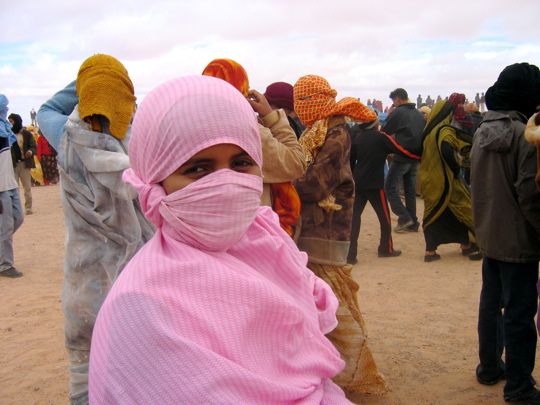
The film types were predictably thrilled with their desert adventure
and soon went about in Saharawi chic-brightly colored scarves and
robes for the women, black turbans for the men. Everybody, the
film stars included, bunked with Saharawi families. Food was rice or
couscous, served with what might have been camel. The refugees
had gone all out for their visitors. Food can be scarce here, along
with everything else. In the heat of the day, the family I stayed
with crowded into the relative cool of their mud house, barefoot on
the rug floor. Out came a portable cassette player and the women
and girls danced, usually to Arab music but often to Latin salsa. I
didn't learn much about Saharawi dancing, but they did manage to
teach me to say "Aneh okut!" That means "I'm lost," which I often
was in the camp's featureless maze of makeshift abodes and
seemingly directionless "streets."
The festival ended with an awards ceremony. The winner for best
film, Senegalese director Moussa Sene Absa, was presented with a
white camel. Not a statue, but an actual albino dromedary. After
many thanks and a bit of a ride around, he graciously announced he
would donate it to his hosts.
All Material Copyright Samuel Loewenberg